



Every site matters. Every case counts.

Register now and help us make PrAKI impossible to ignore.
You are the clinicians. You are in the room when this happens.
For the first time, WITH YOUR HELP, we have
the tools, the network and the moment to count every case in every country, and turn that evidence
into action that saves lives.
We cannot do this without you.

Register Interest

Watch the Global PrAKI Snapshot Q&A session

If you missed the Global PrAKI Snapshot Q&A session, watch it here.

Discover More
HELP THE PEOPLE

STUDY DESIGN — About the study

This two-phase snapshot aims to describe the current burden of PrAKI globally.
PrAKI kills mothers and babies at rates 30 times higher in low-income countries than in wealthy ones, yet its true global burden has never been measured. This study will change that. It follows the model of the ISN 0by25 programme. Findings will be published in a high-impact international journal and used to influence policy, funding and clinical practice worldwide.

4 weeks — COMMITMENT ONLY
All settings — WORLDWIDE WELCOME
We need you — EVERY SITE COUNTS
30 June 2026 — REGISTER YOUR SITE NOW
Register Now!

Contact: PrAKI.Consortium@kcl.ac.uk | www.PrAKI.org

Method Observational cross-sectional global snapshot — a global service evaluation/audit
Population Pregnant and postpartum women with AKI
Inclusion Pregnant women and women up to 6 weeks postpartum with suspected or confirmed PrAKI
Exclusion Chronic dialysis or renal transplantation
Site Eligibility Sites providing antenatal, labour and/or postpartum care, AND/OR receiving referrals of women with PrAKI
Duration Global window: 12 weeks. Each site self-selects a 4-week period.
Definitions KDIGO definitions adopted, with an adapted definition for suspected PrAKI for settings without creatinine access.

Figure 1: Definitions of confirmed and suspected PrAKI

Confirmed AKI — meet one of:

• Serum creatinine rise ≥26μmol/L within 48 hours
• Serum creatinine rise of ≥1.5 times baseline
• Urine output 6 consecutive hours

Suspected PrAKI — meet one of:

• Serum creatinine >77μmol/L
• Strong clinical suspicion with preceding pregnancy-associated risk events
• Subjective reduced urine output
• Indication from point-of-care testing

Who can take part and what is involved

PARTICIPATION —

Who can take part:
• Facilities which provide antenatal, labour and/or postpartum care

AND/OR
• Receive referrals of women with suspected or confirmed PrAKI

No nephrologist required · No creatinine lab needed · All countries welcome · All care settings welcome

What is involved:
Data collection window:
12 weeks globally, September to November 2026.
Each site self-selects one 4-week period.

Data entry:
Simple online platform — approx. 15–20 minutes per case.
Paper tools available. Any trained clinician may enter data. Retrospective entry permitted.

Second window:
March–May 2027. Optional but encouraged.

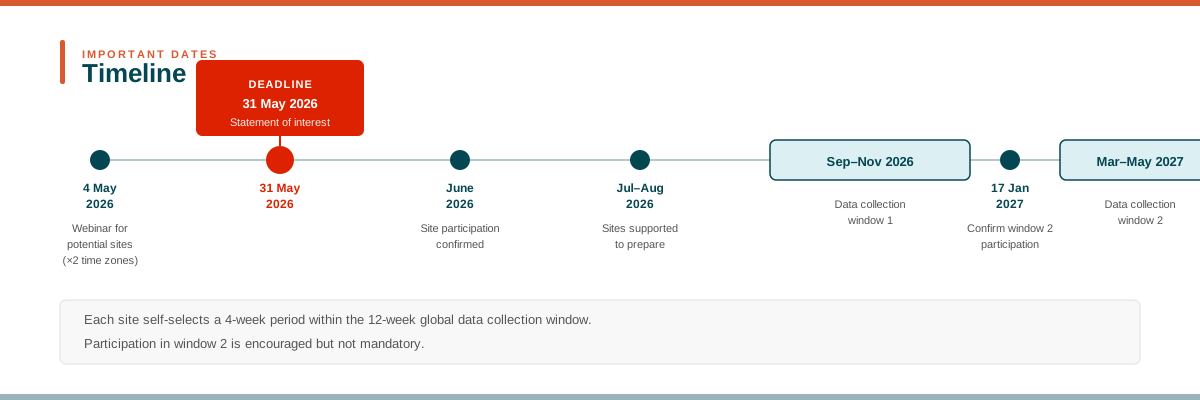
Project Timeline

Week of 4 May 2026Information webinars for potential sites (repeated across time zones)
30 June 2026DEADLINE: Statement of interest for data collection window 1
June 2026Site participation confirmed
July–August 2026Site preparation, training and data dictionary shared
Sept–Nov 2026Data collection window 1
17 January 2027Deadline: confirmation for data collection window 2
March–May 2027Data collection window 2

Each site self-selects a 4-week period within the 12-week global window. Window 2 is encouraged but not mandatory.

BENEFITS OF PARTICIPATION

• Named collaborator status — PubMed-citable listing where possible. Eligible for authorship of the primary manuscript.
• Certificate and letter of thanks — formal recognition of your site's contribution.
• Local data for service development — robust local data to guide ongoing service improvement.
• Access to the PrAKI Toolkit — clinical pathway and education materials for your team.
• Priority in future research — first access to window 2 and future Consortium work.
• Contribution to high-impact research — anticipated international peer-reviewed publication.

WELCOME TO CHARITY

Pifoxen Priority is to Help Childrens.

There are many variations of passa of lorem ipsum available, but the majority.

There are many variations of passages of lorem free market to available, but the majority have alteration in some form, by injected humour, or randomised words.

  • Join our Team

  • Quick Fundraising

  • Lorem ipsum dolor sit ame ed consectetur nod.

  • Lorem ipsum dolor sit ame ed consectetur nod.

We’re Here to Support Them

Fundraising for the People and
Causes you Care About

HELP THE PEOPLE

Popular Causes

OUR TESTIMONIALS

What They’re Talking About Company?

READY TO HELP YOU

Happy Volunteers

Dr Katherine Clark

Midwife, UK

Kevin Martin

Volunteers

Jeesica Brown

Volunteers

We Change Your Life & World

We’ve Been Tackling Poverty in Communities to Build a Better Lives

  • 00

    Total Campaigns

  • 00

    Satisfied Donors

  • 00

    Happy Volunteers

FROM THE BLOG

News & Articles

24 May

WHO kidney health resolution win!

The World Health Organsiation (WHO) has taken a historic step

21 Jul

Huge success at Inaugural PrAKI Consortium Meeting

In July 2025, 41 clinicians, researchers, midwives, policy makers and

28 Sep

What the FIGO 2025 Community Told Us About PrAKI

At the FIGO World Congress, 108 colleagues from across Africa

HELP THE PEOPLE

Volunteers Around the World.

Lorem ipsum dolor sit amet, consectetur nod adipisicing elit sed do eiusmod tempor incididunt ut labore et dolore.

Join us now

FREQUENTLY ASKED QUESTIONS

We do not have a nephrologist or dialysis at our site. Can we still take part?

Yes, and your site is among the most important for this study. The highest burden of PrAKI is in settings with the fewest specialist resources, and we need your data to reflect that reality. We will connect you with a regional or national nephrologist who can support data interpretation if needed. You do not need on-site nephrology, ICU, or laboratory capability to participate.

We cannot measure serum creatinine. Can we still participate?

Yes, we really need you to take part. The definition of suspected PrAKI has been specifically designed to include sites without creatinine access. Clinical criteria, including oliguria, oedema, hypertension, and clinical suspicion, are sufficient for case inclusion. The reporting clinician's documented suspicion is accepted. Sites without creatinine testing are actively encouraged to join.

We are in a high-income setting. Are we still eligible?

Yes, we are welcoming sites from anywhere around the world who meet the minimum requirements for participation. We will be proactive in reaching out to sites in low- and middle-income settings as this is where the literature suggests the highest burden of PrAKI is. However, we recognise there is a growing burden in high-income settings too, and also want to compare risk factors and outcomes in different resource settings.

We do not yet have local institutional approval. Can we still register interest?

Yes. The statement of interest form is the first step only and carries no obligation to participate. The study has been designed as a non-interventional service evaluation using anonymised routinely collected data, and under UK HRA and King's College London definitions does not require ethics review or approval. We recognise that governance classifications vary between countries. Sites are responsible for confirming their own local requirements before data collection begins. King's College London will provide supporting documentation to assist with any local approval process, and we do not anticipate significant barriers. If you are uncertain about your local requirements, please contact us and we will advise.

We do not have any doctors at our setting; we are run by nurses and/or midwives. Can we still take part?

Yes, we would like to include all settings that care for women with PrAKI. We will work with you during the set-up time to understand the referral pathways to ensure women you are referring on for additional care are not included in both institutions.

Is there a minimum number of cases we need to record?

No, we are focused on accurate data collection and therefore there is no minimum number of cases. It is important that all suspected cases are recorded. Sites with very low case volumes provide important data, particularly about settings where PrAKI may be underdiagnosed.

What language can data be submitted in?

The data collection tool is in English, with a Google Translate widget to support completion in other languages. Prior to the data collection window opening, we will work with sites to ensure the data requirements are fully understood, using translators where needed.

How much time is involved?

Data entry is estimated at approximately 15–20 minutes per case. Any trained member of the clinical team may enter data, it does not need to be a doctor or senior clinician. Retrospective entry within the 4-week window is permitted. Sites will also be asked to provide a daily denominator of total women admitted during the first three weeks of their window. Attendance at a pre-collection webinar is strongly encouraged but not mandatory.

Will there be any reimbursement?

No, we are sorry there are no funds available to reimburse or incentivise sites to participate in this project, financial or otherwise. However, all involved in data collection will be listed as part of the PrAKI Global Snapshot working group and named on the website and in any future publication. All data collectors will be recognised as named collaborators, with PubMed-citable collaborator listing where possible. Eligibility for authorship of the primary manuscript will be determined by contribution; further details of the publication policy will be shared with confirmed sites.

How will data be handled and stored?

Data will be handled in line with GDPR (the General Data Protection Regulation, the standard governing data privacy and security that this study adheres to). All data will be anonymised. Data will be shared at the end of the data collection period without declaration of the dates of data collection. Data will be hosted on a secure server managed by King’s College London. Access will be restricted to the core study team. Country and site identifiers will be collected to enable regional analysis, but no patient-level identifying data or dates of birth will be entered. Further information will be shared as available.

What are the expected outputs?

It is expected that this work will be published in a high-impact international peer-reviewed journal. The findings will be widely disseminated with the aim of generating more momentum with key stakeholders including policy makers, funders, industry, change makers and to guide implementation of interventions to prevent, diagnose and manage PrAKI more effectively.

I don't yet know how many cases we will see. Does that matter?

No. There is no minimum case requirement and no penalty for low case numbers. The study is designed to capture the true global picture, including settings where PrAKI is rarely identified. Submitting accurate data, even for zero cases in a window, is valuable information.

Complete the statement of interest before 31 May 2026. There is no obligation.
Questions: PrAKI.Consortium@kcl.ac.uk | www.PrAKI.org

Register your site now